 |  |  |  |
|---|
SPERR [1] (SPeck with ERRor bounding, pronounced spur) is a wavelet-based compression algorithm for 2D and 3D floating-point data that achieves high compression rates. It can bound the pointwise absolute compression error by correcting outliers and is tuned to minimise the combined cost of compression and corrections. SPERR produces a bitstream that can be truncated during decompression to reproduce the data with lower quality more quickly.
SPERR supports three compression modes: (1) targeting a specific compression ratio, (2) bounding the pointwise absolute error, or (3) bounding the peak signal-to-noise ratio.
from pathlib import Path

import netCDF4
import numpy as np
import xarray as xr
data = Path("data")import earthkit.plots
from quickplot import quickplotImporting the Sperr compressor
from numcodecs_wasm_sperr import Sperr?SperrInit signature: Sperr(mode, _version='0.2.0', bpp=None, psnr=None, pwe=None, q=None)
Docstring:
Codec providing compression using SPERR.
Arrays that are higher-dimensional than 3D are encoded by compressing each
3D slice with SPERR independently. Specifically, the array's shape is
interpreted as `[.., depth, height, width]`. If you want to compress 3D
slices along three different axes, you can swizzle the array axes
beforehand.
Parameters
----------
mode : ...
- "bpp": Fixed bit-per-pixel rate
- "psnr": Fixed peak signal-to-noise ratio
- "pwe": Fixed point-wise (absolute) error
- "q": Fixed quantisation step
_version : ..., optional, default = "0.2.0"
The codec's encoding format version. Do not provide this parameter explicitly.
bpp : ..., optional
positive bits-per-pixel
psnr : ..., optional
positive peak signal-to-noise ratio
pwe : ..., optional
positive point-wise (absolute) error
q : ..., optional
positive quantisation step
File: ~/egu26-compression-sc2.5/.venv/lib/python3.13/site-packages/numcodecs_wasm_sperr/__init__.py
Type: ABCMeta
Subclasses: Targeting a specific compression ratio
SPERR can target a specific compression ratio using:
cr = 10  # x10 compression

# dtype = da.dtype
dtype = np.dtype(np.float64)  # for example

Sperr(mode="bpp", bpp=dtype.itemsize * 8 / cr)
Sperr(mode='bpp', bpp=6.4, _version='0.2.0')Bounding the peak signal-to-noise ratio
SPERR can bound the PSNR using:
psnr = 50  # dB

Sperr(mode="psnr", psnr=psnr)
Sperr(mode='psnr', psnr=50.0, _version='0.2.0')Bounding the pointwise absolute error
SPERR can bound the absolute error using:
eb_abs = 0.1

Sperr(mode="pwe", pwe=eb_abs)
Sperr(mode='pwe', pwe=0.1, _version='0.2.0')Bounding the pointwise relative error
The easiest way to bound the pointwise relative error with SPERR is to transform the relative error bound into an absolute error bound [4] using a metacompressor such as the pw_rel_compressor_plugin in LibPressio [5] or the numcodecs_pw_ratio.PointwiseRatioErrorBoundedCodec port:
from numcodecs_pw_ratio import PointwiseRatioErrorBoundedCodec
from numcodecs_wasm_zstd import Zstd

eb_rel = 0.01

PointwiseRatioErrorBoundedCodec(
    # transform pointwise relative error bound into pointwise ratio error bound
    eb_ratio=1 + eb_rel,
    # mark how the absolute error is configured
    eb_abs_marker="$eb_abs",
    # lossy compressor that will use an absolute error bound
    log_codec={**Sperr(mode="pwe", pwe=4.2).get_config(), "pwe": "$eb_abs"},
    # lossless compressor for compressing the data signs
    sign_codec=Zstd(level=3),
)
PointwiseRatioErrorBoundedCodec(eb_ratio=1.01, eb_abs_marker='$eb_abs', log_codec={'id': 'sperr.rs', 'mode': 'pwe', 'pwe': '$eb_abs', '_version': '0.2.0'}, sign_codec=Zstd(level=3, _version='0.1.0'))Preserving NaN Missing Values
SPERR itself does not support preserving infinite and NaN values and raises an exception when compressing data that includes non-finite values. However, the HDF5 filter plugin for SPERR, H5Z-SPERR [6], which is included in the hdf5plugin Python package for h5py, supports preserving NaN missing values (mode 1) and missing values encoded as a sentinel with magnitude larger than 1e35. Alternatively, a filter such as numcodecs_replace.ReplaceFilterCodec can be used to replace all non-finite values before compressing with SPERR, though this will not recreate these values during decompression:
from numcodecs_combinators.stack import CodecStack
from numcodecs_replace import Replacement, ReplaceFilterCodec

eb_abs = 1.0

CodecStack(
    ReplaceFilterCodec(
        replacements={
            np.nan: "finite_mean",
            -np.inf: "finite_min",
            np.inf: "finite_max",
        }
    ),
    Sperr(mode="pwe", pwe=eb_abs),
)
CodecStack(ReplaceFilterCodec(replacements={nan: 'finite_mean', -inf: 'finite_min', inf: 'finite_max'}), Sperr(mode='pwe', pwe=1.0, _version='0.2.0'))Example
# Load the data
ds = xr.open_dataset(
    data / "hplp" / "hplp_sfc_regridded_t_025deg_levels_steps_204_216_228_240.nc",
    engine="netcdf4",
    decode_timedelta=True,
)
da = ds["2t"]
psnr = 50.0 # dB
codec = Sperr(mode="psnr", psnr=psnr)# encode and decode the data
da_enc = codec.encode(da.values)
da_dec = da.copy(data=codec.decode(da_enc))# plot a comparison figure
fig = earthkit.plots.Figure(
size=(15, 4),
rows=1,
columns=3,
)
quickplot(da, fig.add_map(0, 0), title="Original {default_title}")
quickplot(
da_dec, fig.add_map(0, 1), title="SPERR", cr=da.nbytes / np.array(da_enc).nbytes
)
quickplot(da_dec - da, fig.add_map(0, 2), error=True, title="Compression Error")
fig.show()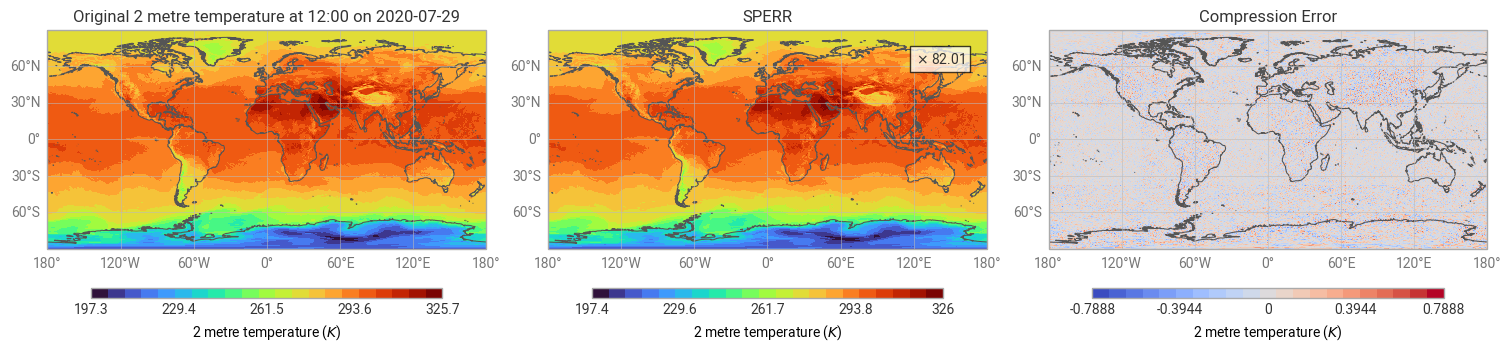
Li, S., Lindstrom, P., & Clyne, J. (2023). Lossy Scientific Data Compression With SPERR. 2023 IEEE International Parallel and Distributed Processing Symposium (IPDPS), 1007–1017. Available from: Li et al. (2023).
Fallin, A., & Burtscher, M. (2024). Lessons learned on the path to guaranteeing the error bound in lossy quantizers. arXiv. Available from: Fallin & Burtscher (2024).
Reichelt, T., Tyree, J., Klöwer, M., Dueben, P., Lawrence, B. N., Baker, A. H., Faghih-Naini, S., Hoefler, T., & Stier, P. (2026). ClimateBenchPress (v1.0): A Benchmark for Lossy Compression of Climate Data. EGUsphere [Preprint]. Available from: Reichelt et al. (2026).
Liang, X., Di, S., Tao, D., Chen, Z., & Cappello, F. (2018). An Efficient Transformation Scheme for Lossy Data Compression with Point-Wise Relative Error Bound. 2018 IEEE International Conference on Cluster Computing (CLUSTER), 179–189. Available from: Liang et al. (2018).
Underwood, R., Malvoso, V., Calhoun, J. C., Di, S., & Cappello, F. (2021). Productive and Performant Generic Lossy Data Compression with LibPressio. 2021 7th International Workshop on Data Analysis and Reduction for Big Scientific Data (DRBSD-7), 1–10. Available from: Underwood et al. (2021).
- Li, S., Lindstrom, P., & Clyne, J. (2023). Lossy Scientific Data Compression With SPERR. 2023 IEEE International Parallel and Distributed Processing Symposium (IPDPS), 1007–1017. 10.1109/ipdps54959.2023.00104
- Fallin, A., & Burtscher, M. (2024). Lessons Learned on the Path to Guaranteeing the Error Bound in Lossy Quantizers. arXiv. 10.48550/ARXIV.2407.15037
- Reichelt, T., Tyree, J., Klöwer, M., Dueben, P., Lawrence, B. N., Baker, A. H., Faghih-Naini, S., Hoefler, T., & Stier, P. (2026). ClimateBenchPress (v1.0): A Benchmark for Lossy Compression of Climate Data. 10.5194/egusphere-2026-60
- Liang, X., Di, S., Tao, D., Chen, Z., & Cappello, F. (2018). An Efficient Transformation Scheme for Lossy Data Compression with Point-Wise Relative Error Bound. 2018 IEEE International Conference on Cluster Computing (CLUSTER), 179–189. 10.1109/cluster.2018.00036
- Underwood, R., Malvoso, V., Calhoun, J. C., Di, S., & Cappello, F. (2021). Productive and Performant Generic Lossy Data Compression with LibPressio. 2021 7th International Workshop on Data Analysis and Reduction for Big Scientific Data (DRBSD-7), 1–10. 10.1109/drbsd754563.2021.00005