 |  |  |  |
|---|
LC [1] is a framework for constructing modular lossless and lossy compressors from a collection of preprocessors and components. LC provides cross-platform compression that is guaranteed to produce the same results on CPUs and GPUs. LC supports pointwise absolute, relative, and normalised error bounds using quantisation-based preprocessors.
LC’s native implementation [2] also provides tools to find optimal compression pipelines using exhaustive search and genetic algorithms.
The implementation in numcodecs-wasm-lc provides a compressor that can be configured with the preprocessor and components that it should consist of.
from pathlib import Path

import netCDF4
import numpy as np
import xarray as xr
data = Path("data")import earthkit.plots
from quickplot import quickplotImporting the Lc compressor
from numcodecs_wasm_lc import Lc?LcInit signature: Lc(components, _version='0.1.0', preprocessors=[])
Docstring:
Codec providing compression using LC
Parameters
----------
components : ...
LC components
_version : ..., optional, default = "0.1.0"
The codec's encoding format version. Do not provide this parameter explicitly.
preprocessors : ..., optional, default = []
LC preprocessors
File: ~/egu26-compression-sc2.5/.venv/lib/python3.13/site-packages/numcodecs_wasm_lc/__init__.py
Type: ABCMeta
Subclasses: Available Preprocessors
NUL: no-op,{"id": "NUL"}LOR: 1D Lorenzo predictor over 32 bit signed integers, e.g.{"id": "LOR", "dtype": "i32"}QUANT: lossy absolute (ABS) / relative (REL) / normalised-absolute (NOA, also known as range-relative) error-bounded quantisation for 32/64 bit floating point values with zero (0) or random (R) decorrelation, e.g.{"id": "QUANT", "dtype": "f64", "kind": "ABS", "error_bound": 0.1, "decorrelation": "R"}
The complete list of supported preprocessors can be inspected by providing an invalid id:
try:
    Lc(preprocessors=[{"id": "???"}])
except Exception as err:
    print(err)
 1 | {"preprocessors":[{"id":"???"}]}
   |                              ^ unknown variant `???`, expected one of `NUL`, `LOR`, `QUANT` at line 1 column 29
Available Components [3][4]
NUL: no-op,{"id": "NUL"}Mutators:
TCMS: convert from integer two’s complement to sign-magnitude representation for 1/2/4/8-byte values, e.g.{"id": "TCMS", "size": 1}TCNB: convert from integer two’s complement to negabinary representation for 1/2/4/8-byte values, e.g.{"id": "TCNB", "size": 2}DBEFS: convert from IEEE 754 floating point to debiased exponent fraction sign representation for 4/8-byte values, e.g.{"id": "DBEFS", "size": 4}DBESF: convert from IEEE 754 floating point to debiased exponent sign fraction representation for 4/8-byte values, e.g.{"id": "DBESF", "size": 8}
Shufflers:
BIT: bit shuffle for 1/2/4/8-byte values, e.g.{"id": "BIT", "size": 1}TUPL: tuple shuffle for 2/3/4/6/8/12-element tuples of 1/2/4/8-byte values, e.g.{"id": "TUPL", "size": "12_1"}
Predictors:
DIFF: delta for 1/2/4/8-byte values, e.g.{"id": "DIFF", "size": 2}DIFFMS: delta as sign-magnitude for 1/2/4/8-byte values, e.g.{"id": "DIFFMS", "size": 4}DIFFNB: delta as negabinary for 1/2/4/8-byte values, e.g.{"id": "DIFFNB", "size": 8}
Reducers:
CLOG: chunked leading-zero-bit elimination for 1/2/4/8-byte values, e.g.{"id": "CLOG", "size": 1}HCLOG: hybrid chunked leading-zero-bit elimination for 1/2/4/8-byte values, e.g.{"id": "HCLOG", "size": 2}RARE: repeated adaptive redundancy elimination for 1/2/4/8-byte values, e.g.{"id": "RARE", "size": 4}RAZE: repeated adaptive zero elimination for 1/2/4/8-byte values, e.g.{"id": "RAZE", "size": 8}RLE: run-length encoding for 1/2/4/8-byte values, e.g.{"id": "RLE", "size": 1}RRE: repeated redundancy elimination for 1/2/4/8-byte values, e.g.{"id": "RRE", "size": 2}RZE: repeated zero elimination for 1/2/4/8-byte values, e.g.{"id": "RZE", "size": 4}
The complete list of supported components can be inspected by providing an invalid id:
try:
    Lc(components=[{"id": "???"}])
except Exception as err:
    print(err)
 1 | {"components":[{"id":"???"}]}
   |                           ^ unknown variant `???`, expected one of `NUL`, `TCMS`, `TCNB`, `DBEFS`, `DBESF`, `BIT`, `TUPL`, `DIFF`, `DIFFMS`, `DIFFNB`, `CLOG`, `HCLOG`, `RARE`, `RAZE`, `RLE`, `RRE`, `RZE` at line 1 column 26
Bounding the pointwise absolute error
LC can bound the absolute error using the ABS kind of the QUANT preprocessor:
eb_abs = 1.0

Lc(
    preprocessors=[
        {
            "id": "QUANT",
            "dtype": "f64",
            "kind": "ABS",
            "error_bound": eb_abs,
            "decorrelation": "0",
        }
    ],
    components=[
        # e.g. bit shuffle and run-length encoding over 8 byte floating point
        {"id": "BIT", "size": 8},
        {"id": "RLE", "size": 8},
    ],
)
Lc(preprocessors=[{'id': 'QUANT', 'dtype': 'f64', 'kind': 'ABS', 'error_bound': 1.0, 'threshold': None, 'decorrelation': '0'}], components=[{'id': 'BIT', 'size': 8}, {'id': 'RLE', 'size': 8}], _version='0.1.0')Bounding the range-relative error
LC can bound the range-relative error using the NOA kind of the QUANT preprocessor:
eb_range_rel = 0.01  # 1% of max(data) - min(data)

Lc(
    preprocessors=[
        {
            "id": "QUANT",
            "dtype": "f64",
            "kind": "NOA",
            "error_bound": eb_range_rel,
            "decorrelation": "0",
        }
    ],
    components=[
        # e.g. bit shuffle and run-length encoding over 8 byte floating point
        {"id": "BIT", "size": 8},
        {"id": "RLE", "size": 8},
    ],
)
Lc(preprocessors=[{'id': 'QUANT', 'dtype': 'f64', 'kind': 'NOA', 'error_bound': 0.01, 'threshold': None, 'decorrelation': '0'}], components=[{'id': 'BIT', 'size': 8}, {'id': 'RLE', 'size': 8}], _version='0.1.0')Bounding the pointwise relative error
LC can bound the relative error using the REL kind of the QUANT preprocessor:
eb_rel = 0.01

Lc(
    preprocessors=[
        {
            "id": "QUANT",
            "dtype": "f64",
            "kind": "REL",
            "error_bound": eb_rel,
            "decorrelation": "0",
        }
    ],
    components=[
        # e.g. bit shuffle and run-length encoding over 8 byte floating point
        {"id": "BIT", "size": 8},
        {"id": "RLE", "size": 8},
    ],
)
Lc(preprocessors=[{'id': 'QUANT', 'dtype': 'f64', 'kind': 'REL', 'error_bound': 0.01, 'threshold': None, 'decorrelation': '0'}], components=[{'id': 'BIT', 'size': 8}, {'id': 'RLE', 'size': 8}], _version='0.1.0')Preserving Missing Values
NaN values and infinities are automatically preserved by LC.
Example
# Load the data
ds = xr.open_dataset(
    data / "hplp" / "hplp_sfc_regridded_t_025deg_levels_steps_204_216_228_240.nc",
    engine="netcdf4",
    decode_timedelta=True,
)
da = ds["2t"]
eb_abs = 0.1 # 0.1 K
codec = Lc(
preprocessors=[
{
"id": "QUANT",
"dtype": "f64",
"kind": "ABS",
"error_bound": eb_abs,
"decorrelation": "0",
}
],
components=[
# e.g. bit shuffle and run-length encoding over 8 byte floating point
{"id": "BIT", "size": 8},
{"id": "RLE", "size": 8},
],
)# encode and decode the data
da_enc = codec.encode(da.values)
da_dec = da.copy(data=codec.decode(da_enc))# plot a comparison figure
fig = earthkit.plots.Figure(
size=(15, 4),
rows=1,
columns=3,
)
quickplot(da, fig.add_map(0, 0), title="Original {default_title}")
quickplot(da_dec, fig.add_map(0, 1), title="LC", cr=da.nbytes / np.array(da_enc).nbytes)
quickplot(da_dec - da, fig.add_map(0, 2), error=True, title="Compression Error")
fig.show()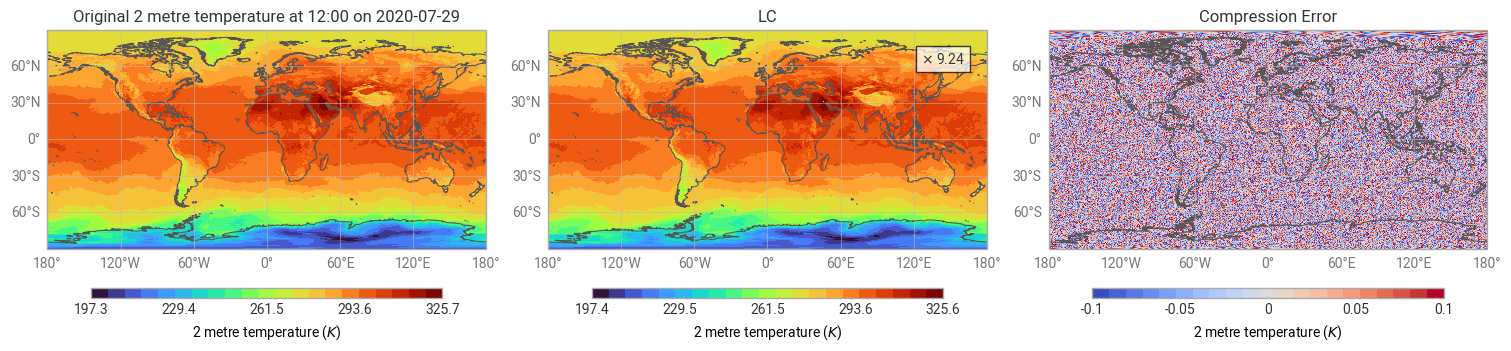
Fallin, A., & Burtscher, M. (2024). Lessons learned on the path to guaranteeing the error bound in lossy quantizers. arXiv. Available from: Fallin & Burtscher (2024).
Azami, N. & Burtscher, M. (2025). Identifying Important Data Transformations for Synthesizing Effective Lossless Compressors. 2025 IEEE International Symposium on Performance Analysis of Systems and Software (ISPASS), 286–296. Available from: Azami & Burtscher (2025) and https://
userweb .cs .txstate .edu / ~burtscher /papers /ispass25 .pdf. Azami, N., Fallin, A., & Burtscher, M. (2025). Efficient Lossless Compression of Scientific Floating-Point Data on CPUs and GPUs. ASPLOS '25: Proceedings of the 30th ACM International Conference on Architectural Support for Programming Languages and Operating Systems, 1, 395–409. Available from: Azami & Burtscher (2025) and https://
userweb .cs .txstate .edu / ~burtscher /papers /asplos25 .pdf.
- Fallin, A., & Burtscher, M. (2024). Lessons Learned on the Path to Guaranteeing the Error Bound in Lossy Quantizers. arXiv. 10.48550/ARXIV.2407.15037
- Azami, N., & Burtscher, M. (2025). Identifying Important Data Transformations for Synthesizing Effective Lossless Compressors. 2025 IEEE International Symposium on Performance Analysis of Systems and Software (ISPASS), 286–296. 10.1109/ispass64960.2025.00034